

Masonry projects across Shepperton
Our masonry projects provide an insight into the range of work we undertake across Shepperton and surrounding areas. Accurate Brickwork Solutions Ltd brings over 30 years of experience to residential and commercial masonry projects, including traditional and modern brickwork, restoration, conservation, stonework, concrete work and new-build construction. We approach each project with careful planning, skilled workmanship and attention to structural integrity, while considering the character and requirements of the property. From maintaining existing masonry to creating new structures, our practical approach helps ensure each stage is completed with care, clear communication and attention to detail.


THREE BESPOKE
MASONRY COMMISSIONS
Private Residence | Wraysbury

CASE STUDY
A collection of three highly individual commissions demonstrating the breadth of specialist masonry: a purpose-made sculpture plinth, the repair and reinstatement of a damaged ornamental fruit finial, and a bespoke adaptation to an existing stone feature for the display of an Indian celebration bowl.
THE COMMON THREAD
Each commission was modest in physical scale but demanded careful judgement. The work was driven by proportion, respect for existing material, close visual scrutiny and the ability to solve unusual problems without allowing the masonry itself to overpower the object or setting it served.
The Story: Three Different Problems, One Craft Approach
These three commissions were undertaken for the same private client in Wraysbury. Although very different in purpose, they share a common character: none could be solved satisfactorily with a standard product or a generic building detail. Each required an individual response.
The first commission was the repair and reinstatement of an ornamental fruit finial after an accidental lawnmower impact caused extensive damage. The client approached ABS Ltd to assess whether the damaged feature could be repaired and returned to its established garden setting.
The second commission was a stone restoration and carving intervention to an existing garden feature. The client wanted the top reworked and flattened to create a considered, level setting for an Indian celebration bowl.
The third and final commission concerned the presentation of a contemporary sculpture by John von Wiese, owner of Cape Bronze Foundry in Cape Town, South Africa, as identified in the client-supplied artist profile. ABS Ltd was asked to turn the client’s idea into a purpose-made stone plinth capable of supporting and visually balancing the tall, asymmetric artwork.
WHY THIS CASE STUDY MATTERS
Together, the three pieces show the value of a masonry contractor who can move comfortably between new fabrication, careful repair and sensitive adaptation. The technical response changes; the standard of finish and respect for context do not.
Commission Overview
01 — Ornamental fruit finial: repair and reinstatement following significant accidental impact damage.
02 — Stone restoration & carving: reworking and flattening an existing stone top to receive an Indian celebration bowl.
03 — Contemporary sculpture: bespoke two-stage stone plinth with concealed fixing provision.
Commission 01 | Damaged Ornamental Fruit Finial
The first commission began with a very different problem. The client had accidentally clipped the edge of a garden finial with a lawnmower, causing substantial localised damage. In his original enquiry he also noted that, after the event, he realised there was no steel attaching the finial to its base.

Condition after impact: extensive loss and fragmentation to the ornamental fruit composition.
CLIENT’S ORIGINAL ENQUIRY
The client asked whether ABS Ltd could look at the damaged finial after the lawnmower impact. The photographs showed that this was not a cosmetic chip: the impact had opened up the centre of the composition and damaged several of the modelled fruit and leaf forms.
The challenge was therefore visual as well as practical. The finial is a dense, three-dimensional composition of fruit, foliage and overlapping forms. Any intervention had to recover the overall silhouette and legibility of the ornament while respecting the surviving original fabric and the naturally aged surface of the piece.
Commission 01 | Repair & Reinstatement

The reinstated finial: the overall fruit-and-foliage composition again reads as a complete architectural ornament.
The completed work restores the finial’s visual continuity without making the garden ornament appear newly manufactured. From normal viewing distance, the repaired piece once again reads as a coherent whole and sits naturally with the weathered pedestal and established garden around it.

Wider view of the finial returned to its garden setting.
This commission illustrates an important principle in small conservation repairs: success is not measured by making an old object look new. It is measured by recovering stability, form and visual coherence while allowing age and character to remain evident.
Scope Delivered
Assessment of impact damage • careful repair and reinstatement of the ornamental composition • recovery of the finial’s overall form • return to its established garden setting.
Commission 02 | Stone Restoration & Carving for an Indian Celebration Bowl
For the second commission, the client wanted to use an existing stone garden feature as the support for an Indian celebration bowl. The requirement was simple to describe but demanded a considered intervention: the top of the existing stone needed to be flattened and adapted so the bowl could sit securely and look intentional within the garden composition.

The newly worked circular stone element, including recessed rings, a textured band and central carved motif.
Rather than treating the task as a crude levelling exercise, the finished stone was worked as a decorative component in its own right. The circular form, recessed concentric detailing, textured band and central motif give the piece a crafted identity even when the bowl is removed.
Commission 02 | Integration with the Existing Garden Feature

The adapted stone element positioned on the existing garden feature before the bowl is placed.
The intervention retains the existing support below and introduces a level, visually resolved top. This allows the client’s bowl to be displayed without disguising the fact that the underlying stone feature is older and of a different character.

Completed arrangement: the Indian celebration bowl positioned on the adapted stone top.
The finished arrangement demonstrates how a small masonry alteration can change the use of an existing garden object without requiring wholesale replacement. The new work provides a purposeful interface between the historic-looking support and the client’s decorative bowl.
Scope Delivered
Assessment of the existing stone feature • flattening and reworking of the top • creation of a purpose-made circular stone element • decorative hand finishing • positioning to receive the client’s Indian celebration bowl.
Craft, Restraint & Problem Solving
Taken individually, each of these projects is a relatively small commission. Taken together, they demonstrate the breadth of judgement required in specialist masonry. The work moves from new fabrication to repair and then to adaptation, but the underlying questions remain consistent: What should be retained? What should be introduced? How much intervention is necessary? And how can the finished masonry serve the object and setting rather than dominate it?
Commission 03 | Bespoke Stone Plinth for a Contemporary Sculpture
The client already owned the sculpture and wanted a base that felt deliberately designed for it rather than simply placed beneath it. The brief developed collaboratively: the plinth needed enough visual weight to anchor the tall, asymmetric work, while remaining quiet enough not to compete with the sculpture itself.

Purpose-made stone components during workshop preparation.
Design Resolution
ABS Ltd developed the idea into a restrained two-stage stone composition: a broad lower block providing mass and stability, with a smaller raised block creating separation and a clear point of connection. The geometry is intentionally simple, allowing the organic movement and dark surface of the artwork to remain the focus.
Proportion — visual balance against a tall, strongly asymmetric sculpture.
Stability — a positive mechanical connection rather than reliance on weight alone.
Material — pale natural stone creating a calm contrast with the dark artwork.
Finish — clean planes, crisp arrises and controlled junctions suitable for close-range viewing.
Installation — a piece designed to sit comfortably within an established home and garden setting.
Commission 03 | Fabrication, Trial Fitting & Installation

The two-stage geometry taking shape in the workshop.
The plinth was produced as a bespoke piece rather than adapted from an off-the-shelf pedestal. Individual stone elements were worked to establish true faces, crisp arrises and the required stepped proportions. A concealed fixing point was formed through the upper stone so that the sculpture could be positively located while keeping the engineering visually discreet.

Workshop trial fitting: proportion, alignment and the relationship between sculpture and plinth checked before final installation.
Trial assembly allowed the complete composition to be judged before installation. The contrast became a defining feature of the finished piece: pale, disciplined masonry below; dark, fluid sculpture above.
Commission 03 | Finished Setting

The completed sculpture and bespoke stone plinth in its domestic setting.
In its final setting, the plinth performs two roles at once. Structurally, it provides a stable foundation and controlled point of connection. Visually, it frames the work without drawing attention away from it. The pale stone catches the natural light while the stepped form gives the sculpture enough elevation to read as a distinct object.
ARTIST ATTRIBUTION
Sculpture by John von Wiese. The client-supplied artist profile identifies John von Wiese as owner of Cape Bronze Foundry, Cape Town, South Africa.
Scope Delivered
Collaborative design development • stone preparation • hand-working and finishing • fabrication of two-stage plinth • concealed fixing provision • workshop trial fitting • final assembly and installation.
What the Three Commissions Demonstrate
Bespoke fabrication — producing one-off stonework to suit a specific artwork rather than forcing the artwork to suit a standard pedestal.
Repair — responding to accidental damage where irregular ornament and surviving aged fabric must be read and respected.
Adaptation — giving an existing stone feature a new purpose through a limited, carefully considered alteration.
Visual judgement — controlling proportion, surface, alignment and contrast so new work belongs in its setting.
Traditional craft in contemporary use — applying hand masonry skills not only to buildings, but to sculpture, garden ornament and unique private commissions.
ABS APPROACH
The smallest commissions can demand the greatest concentration. Where a piece is viewed closely, every arris, junction, line and surface matters. ABS Ltd approaches this work with the same emphasis on material understanding and workmanship applied to larger conservation and restoration projects.
Project Record
Closing Note
These commissions sit at the intersection of masonry, conservation and object-making. They show that specialist stonework does not always arrive as a large façade or structural repair. Sometimes it is a single base, a damaged finial or one carefully altered surface. In each case, the value lies in understanding what the client is trying to achieve and resolving it with proportion, restraint and craft.
ACCURATE BRICKWORK SOLUTIONS LTD
Specialists in the Art of Masonry
CASE STUDY
Period Property Brick Restoration
KT13, Surrey | c.1860 Period Residence

BEFORE

AFTER
The Challenge
An external corner of this c.1860 period home had suffered from layers of modern exterior paint, hard cement repairs and previous alterations. Once the paint was removed, the true extent of damage to the brickwork and architectural detailing became clear.
Conservation, Not Replacement
The objective was to retain as much historic fabric as reasonably possible while reinstating the damaged corner using materials and techniques sympathetic to the age and character of the building. The intention was not to make the masonry look new, but to make the repair belong.
Careful Intervention. Lasting Repair.

AS FOUND

IN PROGRESS

COMPLETED
The Work
Paint and unsuitable residues were carefully removed. Defective masonry was repaired or replaced only where necessary, and the stepped brickwork and projecting detail were rebuilt to recover the original proportions. The masonry was finished with an appropriate traditional mortar rather than an unnecessarily hard modern cement repair.
The Result
A compromised architectural detail was restored while preserving the visual character of the period property. The completed repair sits naturally beside the surviving historic masonry, retaining the age and irregularity that give the building its character.
10/10 VERIFIED CLIENT REVIEW
“I can’t overstate the importance of using someone who has this appreciation. James is this guy. He recently surgically repaired the corner of my house (paint removal/brick repair). He knows his stuff!!!”
Chartered Engineer | Verified Checkatrade Review | March 2025
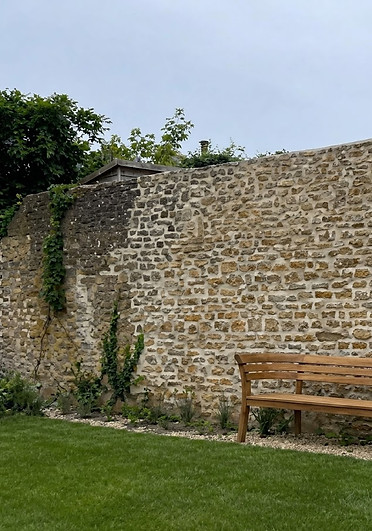
Bargate Stone Garden Wall
Cleaning, lime repointing & sympathetic masonry repair


BEFORE
AFTER
LOCATION
Godalming, GU7
AREA
29.75 m²
WALL
8.5 m × 3.5 m
DRAINAGE
7 weep holes
A heavily weathered historic wall returned to a sound, breathable and visually coherent condition using conservation-led methods.
The Challenge
The existing Bargate stone wall had suffered from prolonged weathering, biological staining and previous hard pointing. The surface was heavily darkened and sections of the masonry were obscured by contamination. A mixture of cementitious pointing and exceptionally hard historic mortar had to be removed without unnecessarily sacrificing the arrises and faces of the irregular stonework.
At low level, moisture management was also an important part of the brief. The work therefore needed to do more than improve appearance: it had to reinstate a compatible mortar system, deal sensitively with local defects and improve the wall’s ability to shed and manage moisture.
Conservation Approach
The wall was treated as historic masonry rather than as a modern uniform substrate. Cleaning, raking out and repointing were carried out progressively, with the character and irregularity of the existing Bargate stone retained. The aim was not to make the wall look new, but to reveal the stone, remove incompatible material and leave a repair that sits quietly within the fabric.
METHOD & CRAFT
From Heavy Staining to Legible Stonework


Steam cleaning — Careful steam cleaning removed accumulated black staining and surface contamination, allowing the natural variation of the Bargate stone to become visible again.
Raking out — Existing mortar was carefully removed to approximately 25 mm where required, including hard and cement-rich pointing, while limiting damage to the stone edges.
Local masonry repairs — Defective areas were addressed selectively and stones identified as damaged beyond serviceable repair were replaced where necessary, retaining sound original material wherever practical.
Lime repointing — Joints were repointed in a compatible lime mortar, worked to follow the natural profiles and variable joint widths of the historic rubble wall rather than imposing an artificial regularity.
Moisture management — Seven core-drilled weep holes were introduced at low level in positions instructed for the works, providing a discreet drainage route through the wall.
Cappings & finish — The works extended to the full height of the wall and included the cappings. Final finishing and clean-down were undertaken to leave a coherent, breathable elevation.
DETAILS THAT MATTER
Repairing Performance, Not Just Appearance


The close-up views show the deliberately restrained finish. Lime mortar has been brought neatly to the irregular stone edges without masking the face of the masonry. The texture remains appropriately open and visually softer than a dense cement joint, while the stone retains its individual shape, tooling and weathering.
The weep holes are intentionally functional and discreet. Rather than concealing an underlying moisture issue behind dense pointing, the intervention gives water a defined route out of the wall while the lime-jointed masonry remains vapour permeable.

COMPLETED WORK & CLIENT FEEDBACK
A Wall Restored to Its Full Glory

The completed elevation demonstrates the value of combining cleaning, mortar replacement, local masonry repair and drainage as one conservation package. The wall is brighter without looking over-cleaned, the pointing is visually recessive, and the historic variation of the masonry remains the dominant feature.
CLIENT REVIEW • 10/10
“James is highly skilled and knowledgeable and has done an excellent job of cleaning, restoring and lime repointing a section of our Bargate stone garden wall. The colour of the stone looks fantastic after careful steam cleaning and the removal of ugly cement pointing, addition of weep holes and replacement of stones damaged over the years have all resulted in a much stronger wall restored to its full glory. Will be getting James back for the next section soon.”
— Tim, verified reviewer • Job location: GU7
Project Summary
This project is a strong example of ABS Ltd’s approach to traditional masonry: understand the existing fabric, remove what is harming it, retain as much original material as possible and use compatible repair materials that allow the wall to continue ageing naturally. The transformation is substantial, but the intervention remains deliberately understated.
ACCURATE BRICKWORK SOLUTIONS LTD
Specialists in the Art of Masonry
Heritage masonry • Lime mortar • Stone repair • Conservation cleaning
